
What Is Acoustic Lighting? Luminaires That Reduce Echo
Short answer
Acoustic lighting combines an LED luminaire with a sound-absorbing felt surface to control both light and echo. Sound absorption is expressed by the NRC value (0–1; 0.70 means that on average 70 per cent of the sound is absorbed). NRC, the fire class of the felt, the total felt area, illuminance (500 lx at the office desk) and glare (UGR < 19) are assessed together.
Glass facades, concrete ceilings, laminate floors and open-plan layouts make today's offices feel spacious, but hard surfaces reflect sound instead of absorbing it. The result is a reverberant space where conversations blur together, phone calls become difficult and people feel tired by the end of the day. Acoustic lighting addresses this together with the lighting by turning the luminaire that has to be on the ceiling anyway into a sound-absorbing surface.
What is acoustic lighting?
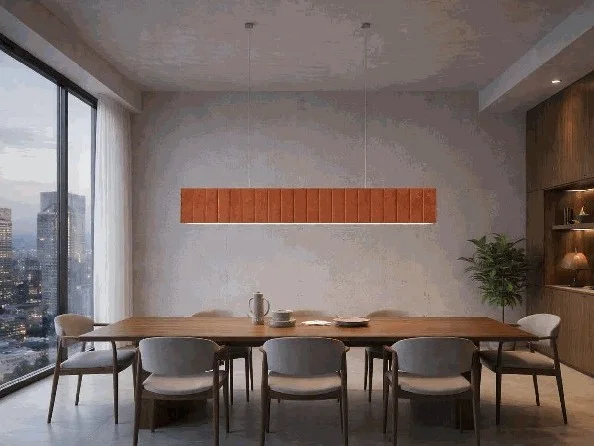
An acoustic luminaire combines an LED light source and a sound-absorbing material in a single body. The absorbing surface is usually recycled PET felt about 9 mm thick. The porous structure of the felt takes in sound energy and turns it into heat, so less sound is reflected back from walls, glass and ceiling and the reverberation time of the room becomes shorter.
The luminaires come in linear, round, oval and panel forms. In some, the felt stands in vertical fins on both sides of the body; in others it forms a wide disc or panel around the light. Finned and wide-surface designs absorb more sound because sound reaches the felt from below and from the sides.
NRC and fire class: what to look for
| Value | What it tells you | Example |
|---|---|---|
| NRC | Average sound absorption at speech frequencies (0–1) | 0.70: on average 70% of the sound is absorbed |
| αs (by frequency) | Sound absorption coefficient at specific frequencies (ISO 354) | 0.80 at 500 Hz, 0.65 at 1000 Hz |
| Fire class (EN 13501-1) | Ignition, smoke and dripping behaviour | B-s1,d0: hard to ignite, little smoke, no dripping |
| Fire class (ASTM E84) | Flame spread under the US standard | Class A: the best class |
In buildings where fire regulations are strictly enforced, such as public buildings, schools, hospitals and shopping centres, the fire class of the felt should be confirmed with a certificate. Recycled PET felt is also light, does not hold dust and is easy to clean.
Where is it used?
- Open-plan offices and call centres: linear acoustic pendants over desk groups improve both task lighting and speech privacy.
- Meeting rooms: a round or oval acoustic luminaire over the table helps voices come through video calls without echo.
- Restaurants and cafés: felt luminaires hung low over tables reduce noise and create a warm atmosphere.
- Schools, libraries and hospitals: they improve speech intelligibility in classrooms and give waiting and rest areas a calm feel.
- Shops and showrooms: in high-ceilinged, hard-surfaced spaces they make conversation between customers and staff easier.
How to choose the right acoustic luminaire
- Light first: the luminaire is above all a lighting product. Under EN 12464-1 the typical target at an office desk is 500 lx; models with lenses and UGR < 19 are preferred to prevent glare at screens.
- Sound absorption: check the NRC of the felt; 0.70 or higher gives good absorption at speech frequencies.
- Total felt area: how much the echo is reduced depends on the total absorbing area in the room. Wide disc, finned or panel models that cover the space better are more effective than a few small luminaires.
- Fire class: ask for a B-s1,d0 or ASTM E84 Class A certificate.
- Colour and appearance: felt colours matter for matching the interior; body colour (white, black, RAL) and felt colour can be chosen separately.
- Control: DALI dimming and daylight sensors save energy; consider an emergency kit for luminaires on escape routes.
Points to consider in the layout
Acoustic pendants are usually hung 1.5–2 metres above the working surface. The closer the luminaire is to the sound source — the people talking — the more noticeable its effect on echo, so placing it directly above meeting and work tables is the most efficient layout. Linear models run parallel to the rows of desks; round models are centred over the table. Calculating illuminance with a program such as DIALux gives the right quantity for both light and appearance. For more, see our lighting design guide.
Can an acoustic luminaire replace panels?
Acoustic luminaires provide a significant part of the required absorbing area on the ceiling without any extra installation. In very large, high-ceilinged and completely hard-surfaced spaces, however, they may need to be planned together with wall and ceiling panels to reach the target reverberation time. For critical projects, a reverberation time calculation by an acoustic consultant is recommended.
Conclusion
Acoustic lighting meets two needs with a single ceiling element: correct, glare-free light and a calmer, more intelligible space. You can browse our acoustic lighting products in linear, ring, disc and panel forms, and request a lighting design for your office or meeting space.
Frequently Asked Questions
What is acoustic lighting?
A lighting solution in which an LED luminaire is combined with a sound-absorbing surface, usually recycled PET felt. The luminaire provides light while the felt reduces reflections of speech and noise.
What does the NRC value tell you?
NRC (Noise Reduction Coefficient) shows, on a scale from 0 to 1, how much sound a material absorbs on average at speech frequencies. NRC 0.70 means that on average 70 per cent of the sound hitting the surface is absorbed.
Can an acoustic luminaire replace acoustic panels?
Not always on its own. How much the echo is reduced depends on the total sound-absorbing area in the room. Acoustic luminaires provide part of the required absorption on the ceiling, together with the lighting; large and very hard spaces are planned with wall or ceiling panels as well.
Are felt luminaires safe in terms of fire?
Check the fire class of the felt. Class B-s1,d0 under EN 13501-1 means the material is hard to ignite, produces little smoke and does not drip when burning; the US equivalent is ASTM E84 Class A.