
What Is Rope Lighting? System, Components and Installation
Short answer
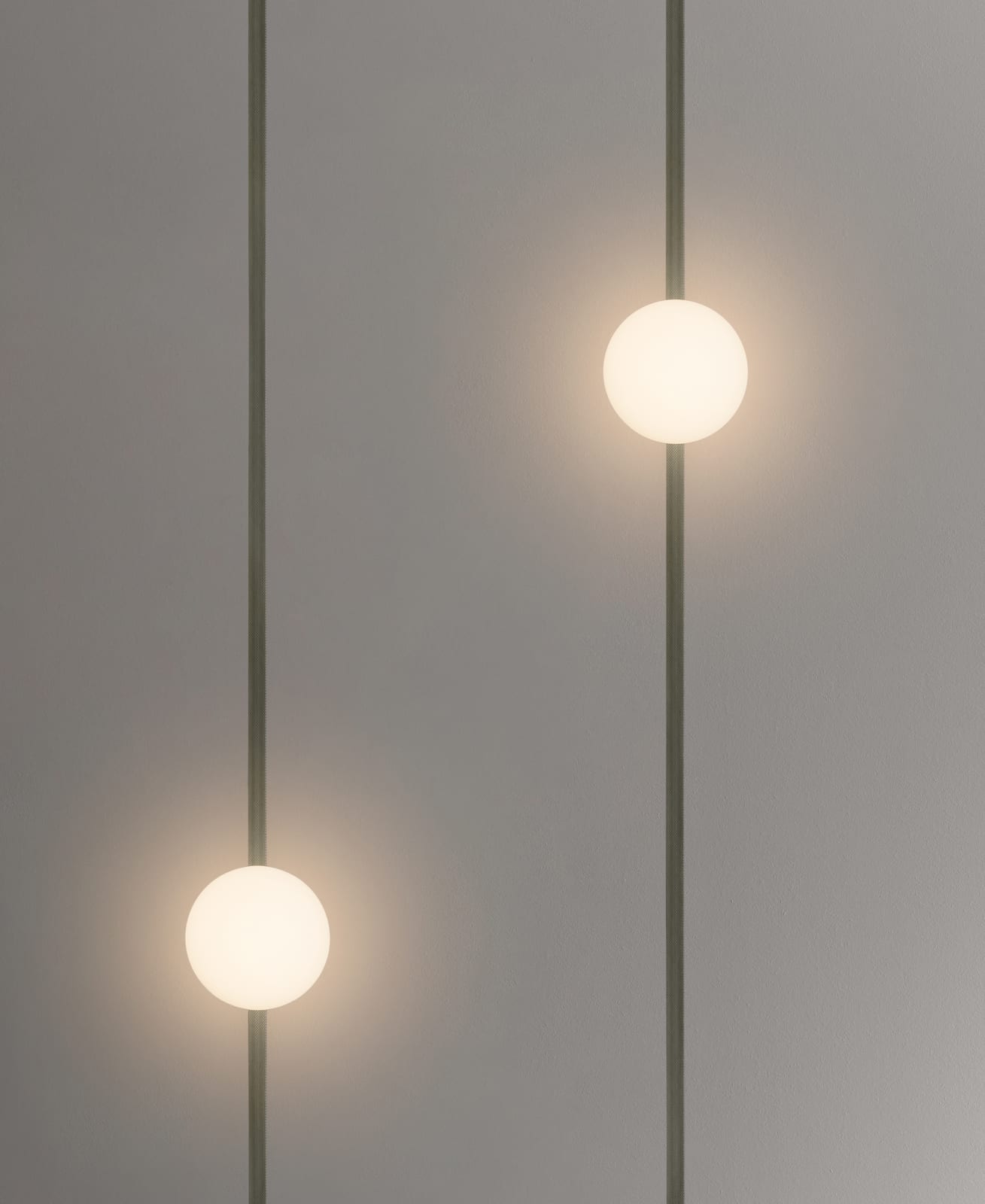
Rope lighting is a lighting system in which luminaires are clipped onto a flexible rope carrying 48 V DC conductors. The rope both carries the luminaires and supplies power; it can hang from the ceiling or be stretched from ceiling to wall or wall to wall. The total power of luminaires on one 150 W driver must not exceed 150 W, and as the system is IP20 it is used in dry indoor spaces.
Picture a fine line above a restaurant's tables, dropping from the ceiling and anchoring to the wall. Opal globes or cones sit along it at different heights, yet there is no ceiling box, no track profile and no separate cable per luminaire in sight. That is exactly what rope lighting does: it combines the carrier and the power line in a single flexible rope.
What is rope lighting?
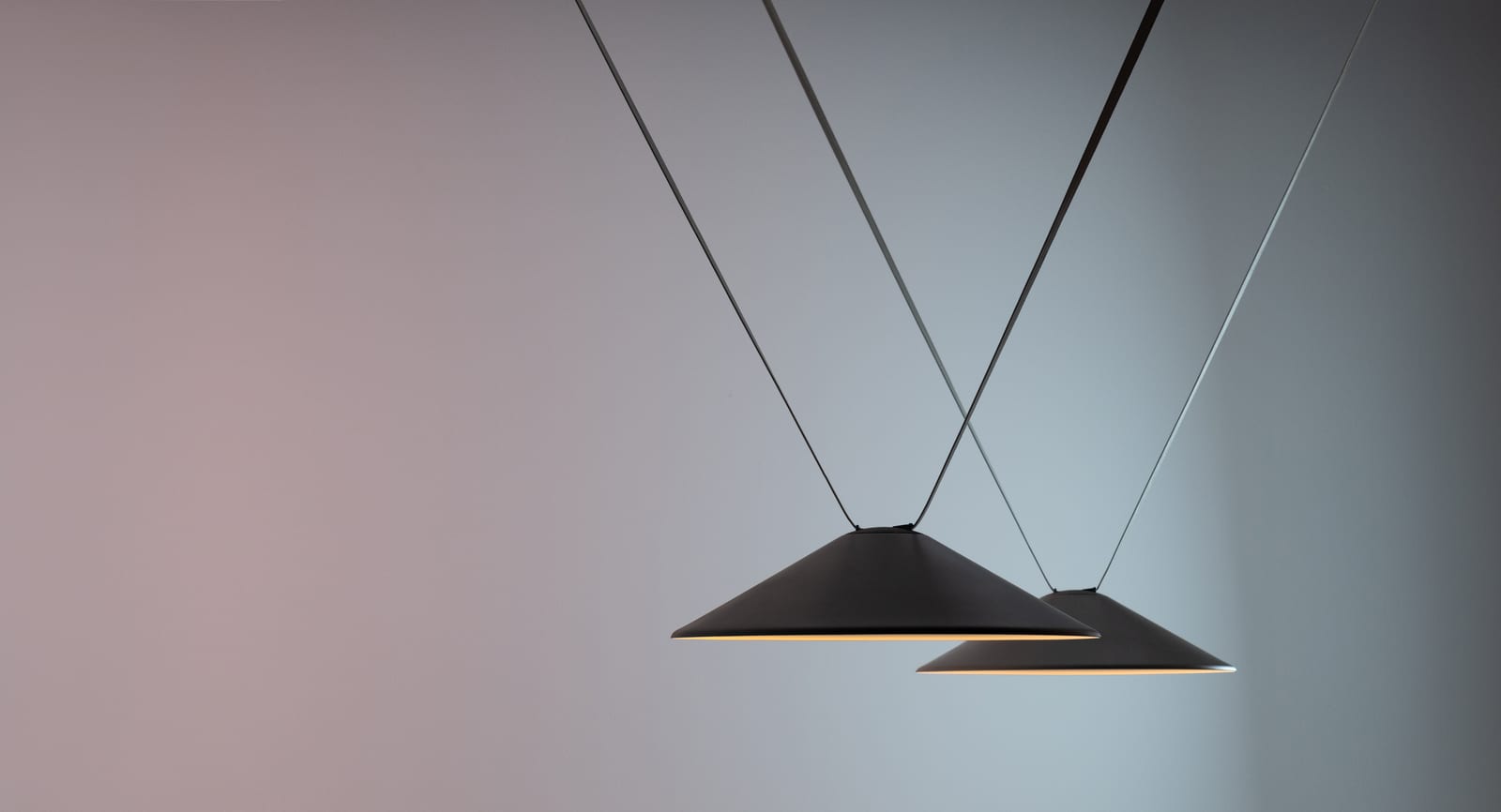
Rope lighting is a low-voltage lighting system in which luminaires are clipped onto a flexible rope carrying 48 V DC conductors. The rope works like a track: the luminaire attaches with a clamp, slides to any point along the rope and is fixed there. The rope can hang from the ceiling or be stretched from ceiling to wall or wall to wall, so luminaires are arranged along free lines, V shapes or arcs rather than a straight run.
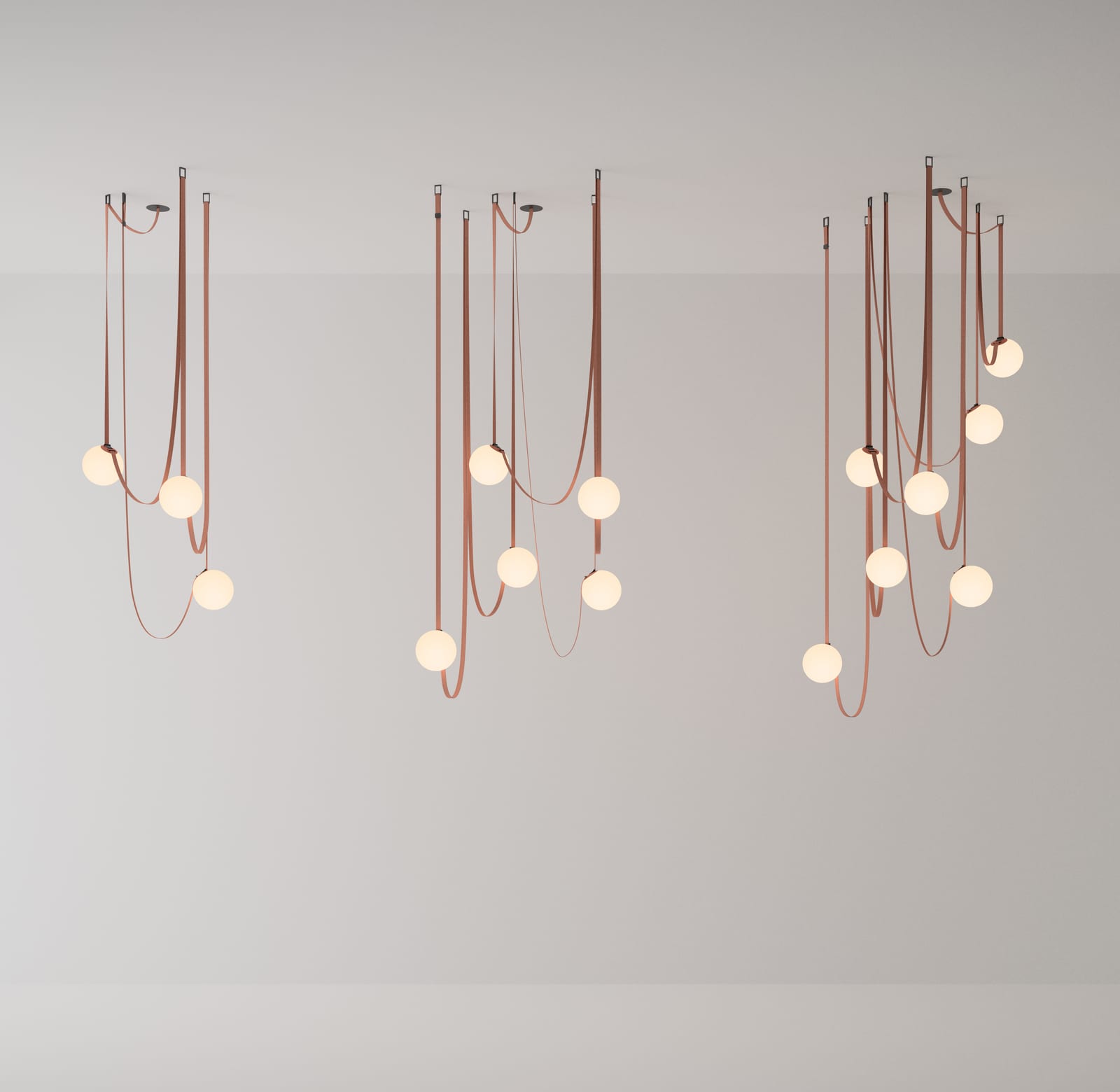
What sets rope lighting apart from magnetic track is its flexibility. Both run on 48 V, but magnetic track is a straight profile recessed into or fixed to the ceiling. Rope draws a line through the space: it fills the void of a high-ceilinged lobby, drops low over a group of tables or runs along a wall.
System components
| Component | Function |
|---|---|
| Rope track | Flexible rope with built-in 48 V conductors that carries and powers the luminaires (27 mm wide, 20 m roll in Corda) |
| Driver | Converts the 220–240 V mains to 48 V DC; 150 W in the Corda system |
| Driver box and rope distributor | Conceals the driver at the ceiling and distributes the rope in one or more directions |
| Recessed junction box | The rope's entry point into a suspended ceiling; the driver stays inside the ceiling |
| External driver feed connector | Powers the rope when the driver is remote (in the ceiling void or a cabinet) |
| Tensioner (short / long) | Keeps the rope taut on the wall or ceiling and fixes its length |
| Surface-mounted rope holder | Guides the rope to the ceiling or wall and supports it at intermediate points |
| End cap | Closes the end of the rope and protects the conductors |
All parts of the Corda system, with dimensions and codes, are listed on the rope track and accessories page.
Driver power and number of luminaires
The driver rating sets how many luminaires a rope can take. The rule is simple: the total power of the luminaires on the rope must not exceed the driver power. Leaving a margin of about 10–20 per cent so the driver does not run at full load continuously is good practice.
| Luminaire | Power | Maximum on a 150 W driver |
|---|---|---|
| Opal globe Ø95 | 6 W | 25 pcs |
| Cylinder tube | 8 W | 18 pcs |
| Spotlight | 9 W | 16 pcs |
| Opal globe Ø135 | 12 W | 12 pcs |
| Dome, cone, disc, linear | 15 W | 10 pcs |
Different luminaires can share the same rope; their powers are then added up. For example, 4 domes (60 W) and 8 small globes (48 W) total 108 W and fit comfortably on one driver.
Installation: a line from ceiling to wall
- Draw the line: decide on the plan where the rope leaves the ceiling, where it anchors on the wall and at what height the luminaires hang. Table luminaires usually sit 70–90 cm above the table top.
- Choose the feed point: use a recessed junction box in a suspended ceiling, or the driver box and rope distributor on a concrete ceiling.
- Tension the rope: fix the rope at the wall end with a short or long tensioner; use surface-mounted holders at intermediate points.
- Fit the luminaires: luminaires clip onto the rope and slide to the required point; they can be moved later.
- Close the end: close the open end of the rope with an end cap.
Where is it used?
- Restaurants and cafés: globes or domes hanging low over rows of tables create an intimate island of light at each table.
- Hotel lobbies and atriums: ropes dropping from a high ceiling fill the void and bring the space down to human scale.
- Shops and showrooms: spotlights and linear luminaires accent windows and counters, and can be slid along as the display changes.
- Homes: they draw a decorative line in double-height living rooms, stairwells and over dining tables.
Checklist for the right choice
- Light needed: choose downward luminaires such as domes, cones or spotlights over tables and counters, and all-round luminaires such as opal globes or tubes for ambient light.
- Colour temperature and rendering: in dining and hospitality spaces, assess colour temperature together with the interior design for a warm atmosphere; Ra > 80 is sufficient for general use.
- Total power: add up the luminaire powers and compare them with the driver rating.
- Conditions: the system is IP20 and is not suitable for bathrooms, outdoors or damp areas.
- Colour match: the rope colour is part of the look; choose luminaire and rope colours together with the interior.
Conclusion
By providing both support and power along a single flexible line, rope lighting lets luminaires be placed freely within a space. You can browse our Corda rope lighting luminaires in dome, cone, globe, disc, spotlight, linear and tube forms, and request a lighting design for your restaurant, hotel or home project.
Frequently Asked Questions
What is rope lighting?
A lighting system in which luminaires are clipped onto a flexible rope carrying 48 V DC conductors. The rope acts as both carrier and power line; luminaires slide to any point along it and are fixed there.
What is the difference between rope lighting and magnetic track?
Both run on 48 V low voltage. Magnetic track is a straight aluminium profile recessed into or fixed to the ceiling; rope is flexible, so it can hang, be stretched crosswise and form free lines from ceiling to wall.
How many luminaires can be used with rope lighting?
The driver rating sets the limit. The total power of the luminaires on a 150 W, 48 V DC driver must not exceed 150 W; for example, up to 10 luminaires of 15 W or 25 small globes of 6 W. Longer runs get a second driver.
Can rope lighting be used in a bathroom or outdoors?
No. The system is rated IP20 and is used only in dry indoor spaces, away from water and high humidity.